
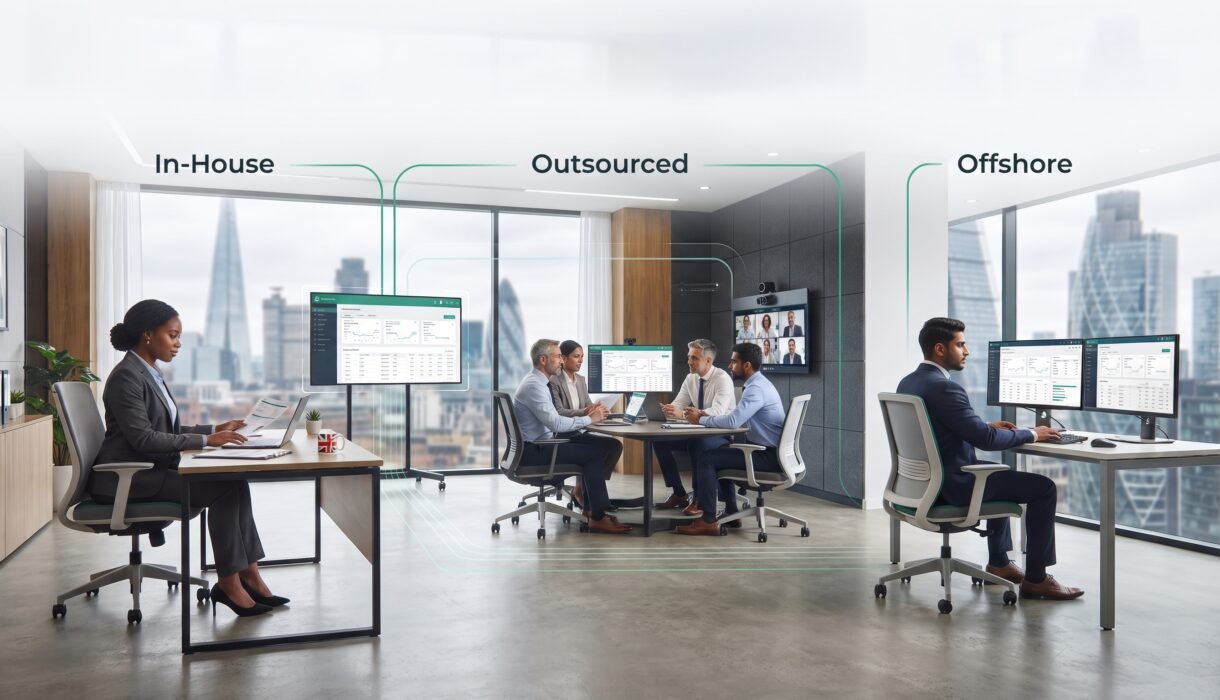
Offshore Accounting vs Outsourced Accounting vs In-House: What’s the Real Difference?
Posted in :

The three models, compared
| Model | Employment relationship | Typical UK cost | Who manages the work | Data & systems access |
|---|---|---|---|---|
| In-house (UK employee) | Direct employee, PAYE | About £2,600–£5,200/mo (£31k–£63k/yr in salary, employer NICs and pension, before recruitment and overheads) | You, day-to-day | Full access, on your own systems |
| Outsourced (accounting firm / BPO) | Client of a third-party firm | Variable — hourly, per-job or a fixed retainer | The firm's account manager and a shared staff pool | The firm's own systems, limited visibility for you |
| Offshore (dedicated seat, e.g. TalentDock) | Full-time team member, employed by the provider | Flat monthly fee: about £790–£2,700 depending on role and seniority (qualified accountants from about £1,470) | You, directly — same as managing an employee | Works inside your own Xero/QuickBooks, under a signed DPA/IDTA |
What each model actually means
In-house
A direct UK employee, hired, trained and managed entirely by you. Full control and full cost — salary, employer NICs, pension auto-enrolment, recruitment, sick pay, and management overhead all sit with you.
Outsourced
A third-party accounting firm or BPO takes on specific tasks or your whole finance function, using their own staff and their own systems. You're a client, not a manager — useful for project work, but you rarely get the same person twice and visibility into the work is limited.
Offshore (dedicated)
A full-time team member, employed and payrolled by a provider like TalentDock, who works exclusively for your business inside your own tools — same as an employee, minus the UK employment cost and admin.
Which model actually fits your business
Choose in-house if
- You need someone physically in a UK office day-to-day
- Budget genuinely isn’t the constraint
- The role needs UK-specific stakeholder management beyond finance
Choose outsourced if
- The work is short-term, seasonal or project-based
- You want a qualified firm’s sign-off, not a managed team member
- You don’t need day-to-day control over how the work gets done
Choose offshore if
- You need consistent, ongoing bookkeeping or accounting support
- You want to manage the person directly, like an employee
- Cost matters and you don’t want to sacrifice dedication or continuity
Common mistakes when choosing between them
- Treating "offshore" and "outsourced" as interchangeable in a contract or a Google search — they carry different cost structures, different control, and different risk profiles.
- Choosing a BPO expecting a dedicated team member, then being surprised when a different person picks up the work each month.
- Assuming offshore means less oversight — with a dedicated-seat model you manage the person directly, the same as any other report.
- Not checking what data protection agreement (DPA) and UK International Data Transfer Agreement (IDTA) is in place before financial data crosses a border, regardless of which model you pick.
- Comparing only headline day rates instead of true fully-loaded cost — UK employer NICs, pension contributions and recruitment fees rarely make it into the in-house comparison.
Cost snapshot: what each model saves or costs you
£31k–£63k/yr
UK cost to employ: salary, employer NICs and pension
50–60%
Typical saving with a dedicated offshore accountant vs UK in-house
Weeks, not months
Time to get an offshore or outsourced arrangement running, vs around six weeks to fill a UK vacancy, plus the new hire's notice period